Valerian Oil COA: How to Read Our Certificate
A Certificate of Analysis looks reassuring, but a lot of buyers do not know what they are looking at. Ours is one page for one batch, and it is more useful once you know what each line says. This is a plain-English tour of the certificate we publish for our Valerian Root Essential Oil, what it tells you, and what to ask for if you need more.
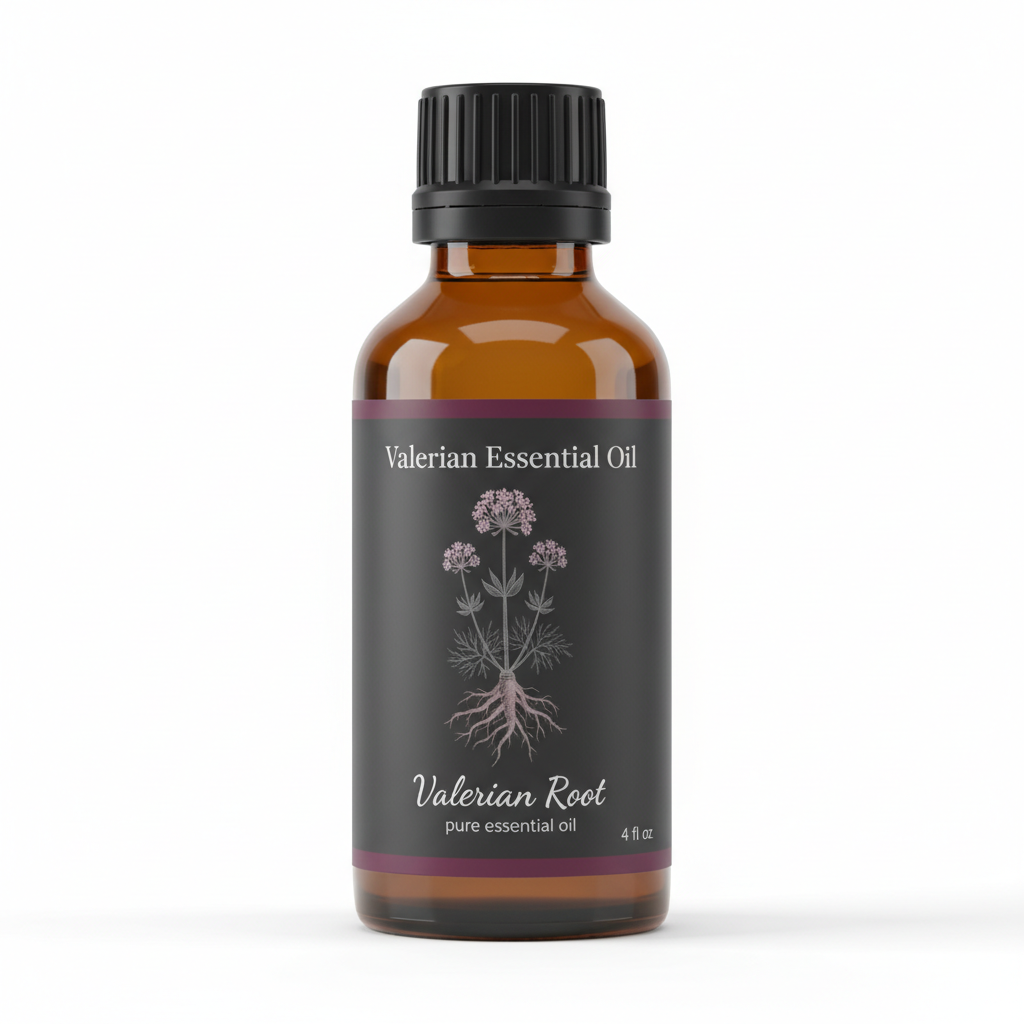
Valerian Root Essential Oil
Our own Valerian Root Essential Oil, in sizes from 0.5 oz to bulk.
From $31.99
Shop Now →The header: who and what
The top of the certificate names the product as Valerian Essential Oil, the batch as VALQGAVOINC005A, the botanical name as Valeriana officinalis and the part used as root. The ingredient line reads "Valeriana officinalis (Valerian) Root Oil", the extraction method is steam distilled, and the best-by date is 04/30/2028. The CAS number, 8008-88-6, is a registry number for the material, not a test result. The best-by date is a shelf-life date rather than a date of analysis. The certificate also lists "Pharmacopoeia" as its criterion of detection without naming which one, so if you need to trace a standard to a document, ask us in writing.
The three measurements
This is the core of the page, and it is quite simple. Each value was measured at 20 C and sits inside the standard range printed beside it:
| Test | This batch | Printed standard |
|---|---|---|
| Relative density | 0.947 | 0.920 to 0.958 |
| Refractive index | 1.473 | 1.445 to 1.480 |
| Optical rotation | -19.80 degrees | -35.00 to -10.00 degrees |
In human terms: relative density compares the oil's weight to water, and 0.947 says this batch is slightly lighter. Refractive index is how much the oil bends light. Optical rotation is how far it turns polarised light, which depends on the mirror-image forms of the molecules inside. We use the density in our own arithmetic, so that 1 ml of this batch is about 0.947 grams. A different lot could land elsewhere in the printed range, which is why we say "this batch" and not "valerian oil".
The certificate also records appearance and smell as complying with the standards printed next to them. Those lines are acceptance wording, not a description of what you will see or smell, so for the scent itself we point you to our honest description.
A practical tip: save the page with the date you looked at it, and note the batch code when you ask us about an order. Months later you will know exactly which batch you were comparing your bottle against.
What physical constants are good at, and what they are not
Constants make a sensible first screen. A crudely wrong oil, or one heavily cut with something thin, can fall outside the windows. But they are summaries: a single number standing in for a whole mixture. That is why the lab literature on adulteration leans on gas chromatography. A University of Turin team studying lavender, lemon and tea tree found that diluting an oil with vegetable oil changed neither the qualitative composition nor the relative percentages of the marker compounds, and that absolute quantitation was needed to reveal it. That work was on other oils, so applying it to valerian is our reasoning, but the logic holds for any oil: matching a window is a good sign, not a proof.
Valerian adds a wrinkle of its own, because genuine samples vary a great deal. In a study of five Estonian root samples distilled the standard way, bornyl acetate ranged from 8.8% to 33.7%, valerenal from a trace to 14.7% and valerianol from 0.3% to 16.7%. The European Medicines Agency's assessment likewise describes the composition as variable, depending on origin. So a certificate with physical constants cannot tell you which chemical profile is in the bottle, and ours does not claim to.
A short checklist for any certificate
Once you can read ours, you can read anyone's. Run down these questions the next time a supplier hands you one:
- Does it name a specific batch, and will your order ship from that batch?
- Are the results measured numbers, or only a word like "complies"?
- Is a printed range beside each number, so you can see what the number was held against?
- Is a laboratory named, and is there a date of analysis?
- Does it say what it covers and what it does not?
Ours gives a batch code, three measured numbers with their printed ranges, and a best-by date. It does not name a laboratory or a date of analysis, and we would rather say so plainly than let you assume.
What the certificate does not contain
The certificate does not include a GC-MS report or any constituent percentages, a laboratory name, a date of analysis, an origin, a flash point, allergen data or an IFRA certificate. If you are formulating a product for sale and need any of those, ask us in writing through the contact page for the lot you will receive, and get the answer in writing before relying on it. The same questions work for any valerian supplier, and our buying guide lists them. If you are weighing species, types of valerian oil explains why the Latin name matters.
We publish it because it gives you something concrete to hold against the bottle in your hand. Smell the oil, read the page, and then ask us anything that is missing in writing. A certificate should start a conversation, not end one.
Read the certificate as what it is: a clear, honest snapshot of three numbers for one batch, offered alongside a bottle you can smell for yourself.
Valerian Root Essential Oil
Valerian Root Essential Oil from our own shop, in sizes from 0.5 oz to bulk.
From $31.99
Shop Now →Sources & Further Reading
- Our Certificate of Analysis, batch VALQGAVOINC005A.
- Capetti F, et al., 2021. Adulteration of Essential Oils: A Multitask Issue for Quality Control. Three Case Studies: Lavandula angustifolia Mill., Citrus limon (L.) Osbeck and Melaleuca alternifolia (Maiden & Betche) Cheel. Molecules.
- Raal A, et al., 2007. Variation in the composition of the essential oil of Valeriana officinalis L. roots from Estonia. Proc Estonian Acad Sci Chem.
- EMA/HMPC, 2016. Assessment report on Valeriana officinalis L., radix and Valeriana officinalis L., aetheroleum (EMA/HMPC/150846/2015).