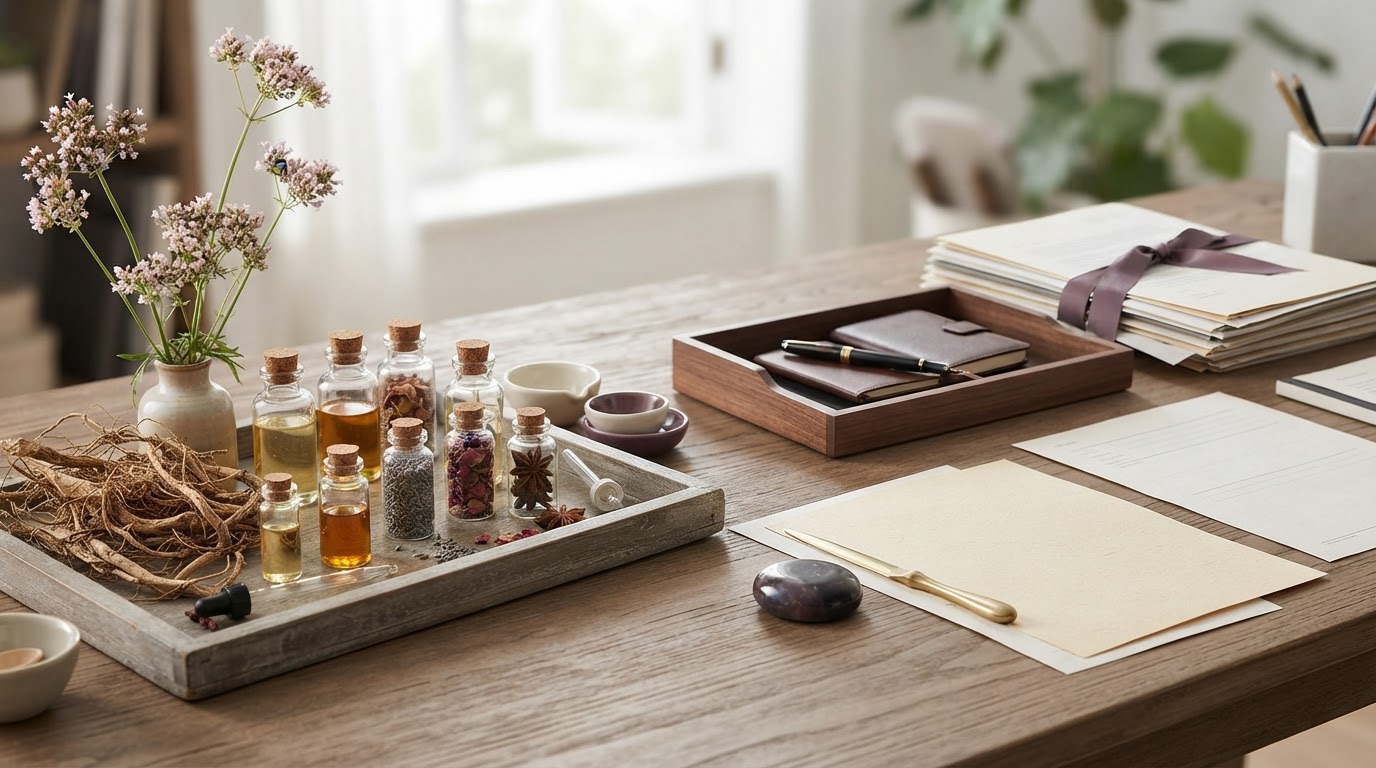
Valerian Oil Uses: The Complete Guide to Evening Rituals and Blending

Key Takeaways
- Valerian essential oil carries a bold, earthy, root-forward scent that anchors slow evening routines and blends beautifully as a base note in natural perfumery.
- The oil is steam-distilled from Valeriana officinalis root and contains compounds such as isovaleric acid, bornyl acetate, and various sesquiterpenes that give it its distinctive character.
- People commonly use valerian oil in diffuser blends, linen mists, bath oils, and personal perfumes oriented around winding down after a long day.
- Proper dilution (0.5–2% for skin applications) and patch testing are essential before topical use.
- Valerian oil pairs well with cedarwood, vetiver, lavender, clary sage, and warm citrus notes like bergamot and mandarin.
- Quality sourcing matters significantly; look for steam-distilled oil with documented GC/MS testing from a reputable supplier.
- Always consult a qualified healthcare provider before introducing new botanicals into your routine, especially if you are pregnant, nursing, or taking medications.
Some essential oils announce themselves gently. Lavender floats in on a soft, floral wave. Peppermint arrives crisp and immediate. Valerian essential oil does neither of those things.
It rises slowly, earthy and dense, like the scent of forest floor after rain mixed with something almost fermented and deeply rooted. For most people, the first encounter is surprising. The second encounter is intriguing. By the third, many find themselves reaching for it deliberately every evening, building rituals around its grounding, atmospheric quality.
This guide covers everything you need to know to work with valerian oil confidently: its chemistry, its scent, the traditional uses people associate with it, practical blending ratios, DIY recipes, sourcing guidance, and the safety information you need before applying it to skin. Whether you are entirely new to this oil or you have a bottle sitting on your shelf and want to use it more creatively, you will find something useful here.
What Is Valerian Essential Oil?
Valerian essential oil is steam-distilled from the dried roots of Valeriana officinalis, a flowering perennial native to Europe and parts of Asia that has since naturalized across North America. The plant grows to roughly five feet tall with clusters of small white or pale pink flowers, but it is the root system that has historically drawn the most attention. The roots are harvested, dried, and then subjected to steam distillation to extract the volatile aromatic compounds that become the essential oil.
It is worth distinguishing between valerian essential oil and valerian root extract. The extract, commonly sold in capsules or tinctures, is a very different product used in a dietary supplement context. The essential oil is an aromatic product. It is used for its scent, for diffusion, for topical application when properly diluted, and for blending in natural perfumery. The two products share a botanical origin but are not interchangeable, and this guide focuses exclusively on the essential oil.
Chemistry at a Glance
Understanding the general chemistry of valerian oil helps explain both its unusual scent and the ways it behaves in blends. The oil contains several notable compound groups:
| Compound Group | Key Examples | Aromatic Contribution |
|---|---|---|
| Carboxylic acids | Isovaleric acid | Sharp, fermented, cheese-like undertone |
| Esters | Bornyl acetate, isoeugenyl isovalerate | Softer, slightly camphorous, rounded |
| Sesquiterpenes | Valerenal, valeranone, beta-caryophyllene | Woody, rooty, earthy depth |
| Monoterpenes | Camphene, alpha-pinene | Fresh, slightly coniferous lift |
The presence of isovaleric acid is largely responsible for the polarizing initial impression. It gives the oil a sharp, almost pungent top note that softens considerably as it dries down. The sesquiterpene fraction is what most experienced blenders are after: a rich, rooty, woody warmth that persists and anchors a blend for hours.
Percentage composition varies depending on the geographic origin of the root, the harvest timing, the drying method, and the distillation conditions. This is one reason GC/MS (gas chromatography/mass spectrometry) testing is so important when evaluating supplier quality, a point we return to in the sourcing section.
The Scent Profile: Learning to Love the Night Root
Valerian is sometimes called the night root, and the name earns its place. This oil smells like nighttime in a forest. It smells like something ancient and below-ground. It has a damp, mossy quality layered over a woody, almost animal warmth, with that sharp isovaleric edge arriving first and retreating as the drier, deeper notes settle in.
Raw from the bottle, valerian oil can be genuinely off-putting to people who expect the clean brightness of most commercial aromatics. But blenders who have worked with it know that raw-from-the-bottle is not how you evaluate it. Diluted, diffused, or layered with complementary notes, it transforms.
Scent Descriptors
- Top notes: Sharp, slightly fermented, earthy, damp moss
- Heart notes: Root-forward, woody, faintly camphorous, green
- Base notes: Deep, warm, balsamic, musky, long-lasting
How It Compares to Similar Oils
People often reach for vetiver as a point of comparison, and there is real overlap in the smoky, earthy, rooty territory both oils occupy. But valerian is wetter, more pungent, and less smoky than vetiver. It sits somewhere between vetiver and angelica root, with more volatile brightness than either.
Spikenard (Nardostachys jatamansi) is a botanical relative of valerian and shares a similarly earthy, root-driven character with slightly more sweetness and less of the sharp fermented note. If you find valerian challenging on first encounter, spikenard can serve as an introductory bridge.
Why Perfumers Value It
In natural perfumery, valerian oil occupies a specific and somewhat irreplaceable position as a rooty, earthy base note with excellent longevity. It can add a sense of depth and groundedness to compositions that might otherwise read as too light or too sweet. A tiny amount, often below 1% of the total formula, is enough to shift the character of an entire blend. For more on working with valerian in this context, see our full guide to valerian in natural perfumery.
Valerian Oil Benefits and Traditional Uses
When people search for valerian oil benefits or benefits of valerian essential oil, they are often looking for two kinds of information: what traditional use records say about the plant, and what contemporary research has begun to examine. Both are worth covering honestly, with the important caveat that essential oil research is still an early and evolving field.
Traditional Use Across Cultures
Valerian root has appeared in traditional botanical records from ancient Greece, Rome, medieval Europe, and various Asian traditions. Historical records describe its use in contexts related to calming, quieting the mind before rest, and supporting a sense of ease during tense or unsettled periods.
The essential oil is a more recent refinement of the plant's use. Traditional applications of the root itself do not translate directly to the essential oil, which has a different chemical profile than water or alcohol extracts of the same plant. Still, the aromatic tradition around valerian is long-standing, and many practitioners of botanical aromatics continue to incorporate it into evening-focused routines based on this historical lineage.
What Some Research Suggests
A modest body of research has examined valerian compounds in laboratory settings and in small human studies. Some research suggests that certain sesquiterpene compounds found in valerian, including valerenal and valeranone, may interact with GABA receptors in ways that could support a sense of calm. However, most of this research has been conducted on extracts rather than the essential oil specifically, and study populations have generally been small.
It is important to be clear: these are research observations, not established clinical conclusions. People report finding valerian oil's scent grounding and conducive to slowing down in the evening. Anecdotal evidence from aromatherapy communities consistently points to its use in bedtime wind-down routines. But we are not in a position to say the oil produces any specific physiological outcome, and no one should use it as a substitute for professional guidance.
The Valerian Oil Benefits Worth Highlighting for Aromatic Use
Setting aside any clinical language, there are practical valerian essential oil benefits that make it a genuinely useful addition to an evening ritual toolkit:
- Atmospheric depth: Its complex, earthy scent creates a distinctive atmosphere that many people associate with winding down and transitioning out of the active day.
- Longevity in blends: As a base note, valerian oil extends the life of diffuser blends and personal fragrances, keeping them present for hours rather than minutes.
- Grounding quality: Many blenders and aromatherapy practitioners describe its scent as grounding: pulling attention inward and downward, away from busy mental chatter.
- Versatility in formulation: Despite its boldness, it integrates well into a wide range of blend types, from linen mists to bath oils to natural perfumes.
- Complementary to wood and resin notes: Valerian oil benefits any blend that needs a rooty, organic earthiness to balance lighter or sweeter elements.

Evening Ritual Applications
The strongest case for valerian essential oil is its role in evening rituals. This is where it shines most naturally, and where its particular aromatic character becomes an asset rather than a challenge.
The concept of an evening ritual is simple: a set of deliberate, sensory-rich actions you perform in the hour or two before bed to signal to your mind and body that the active part of the day is over. Scent is one of the most powerful tools available for this kind of signaling, because the olfactory system connects directly to the limbic region of the brain, which is involved in emotion and memory. Using the same scent consistently in a wind-down context can, over time, build a conditioned association between that scent and a slower, quieter state.
Valerian oil's earthy, night-forest character makes it an ideal anchor for this kind of routine. For a complete approach to building one, see our detailed walkthrough: an evening wind-down ritual with valerian: diffuse and dim.
Diffusion
Diffusing valerian oil is the most accessible entry point. Start with a small number of drops. Because the oil is pungent, less is genuinely more. A typical starting ratio for a 100mL ultrasonic diffuser might be 2 drops of valerian oil blended with 3–4 drops of a softer companion like lavender or cedarwood. Run it for 30–60 minutes rather than continuously through the night.
The scent will shift as it diffuses. The sharp initial note softens within the first 10–15 minutes, leaving the warmer, woodier character to fill the room. This progression is part of what makes valerian oil so suited to a slow evening routine.
Linen and Pillow Mists
A linen mist is one of the most elegant delivery methods for valerian oil. Spritzed lightly onto pillowcases or bedding, the scent sits close to your face through the night, creating an atmospheric envelope without requiring active inhalation or diffusion.
The key to a good valerian pillow mist is dilution and balance. The oil needs to be properly solubilized in the water base (using a dispersant such as polysorbate 20 or a high-proof alcohol), and the formula benefits from companions that soften its sharper notes. For a complete formulation guide with ratios and instructions, visit our DIY valerian pillow mist recipe.
Bath Oils and Soaking Rituals
A warm bath in the early evening is one of the oldest wind-down rituals there is. Adding a properly formulated valerian bath oil brings the oil's atmospheric qualities into a full sensory experience, combining warmth, steam, and scent in a way that invites genuine slowing down.
Bath oil formulation requires care. Essential oils must be dispersed in a carrier oil or an appropriate emulsifier before entering bath water; undiluted essential oil floating on the surface creates a skin contact risk. The standard recommendation is a 1% dilution maximum for bath products, with a carrier like jojoba, sweet almond, or fractionated coconut oil as the base. Our DIY valerian bath oil guide walks through this in full detail.
Personal Fragrance and Pulse-Point Oils
Wearing valerian oil as part of a personal fragrance blend is perhaps the most intimate way to work with it. A small amount applied to pulse points on the wrists and behind the ears will warm with body heat and create a personal scent envelope that shifts through the evening as the lighter notes evaporate and the earthy base remains.
For topical application, always dilute in a carrier oil, patch test first, and stay within the safe dilution ranges outlined in the safety section below. A pulse-point oil formulated at 1–2% total essential oil concentration is a good starting point.
The Blending Guide: How to Work with a Bold Base Note
Valerian oil is what blenders call a dominant note. Used carelessly, it takes over a blend entirely. Used with intention, it gives a blend tremendous depth and staying power. The skill is in proportion and partner selection.
Understanding Dominance in Blending
A useful mental model for blending with valerian is to think of it as a point of gravity in your formula. Everything else orbits around it. This means you generally want partners that are distinctive and aromatic enough to be perceived alongside it, rather than delicate notes that will simply disappear beneath its weight.
The recommended starting range for valerian in a blend is 3–8% of the total essential oil portion of the formula. For diffuser blends, starting as low as 1–2 drops in a 5–6 drop total formula is wise until you understand how it behaves in your specific diffuser and space.
Best Blending Partners
| Partner Oil | Scent Character | Role in Blend | Ratio Suggestion |
|---|---|---|---|
| Cedarwood (Atlas or Virginia) | Warm, woody, dry | Extends the woody base, softens valerian's edge | 30–40% of blend |
| Lavender | Floral, herbaceous, clean | Brightens and lifts; creates contrast | 25–35% of blend |
| Vetiver | Smoky, earthy, deep | Reinforces the earthy base; use sparingly | 5–10% of blend |
| Clary sage | Herbal, slightly sweet, musky | Bridges valerian and lighter notes | 15–20% of blend |
| Bergamot | Citrus, floral, slightly spiced | Provides bright top note contrast | 15–25% of blend |
| Sandalwood | Creamy, warm, woody | Smooths and rounds the overall profile | 10–20% of blend |
| Frankincense | Resinous, slightly citrus, dry | Adds complexity and spiritual depth | 15–25% of blend |
| Mandarin | Sweet, bright citrus | Softens valerian's intensity with sweetness | 20–30% of blend |
Notes to Approach with Caution
Some oils compete poorly with valerian rather than complementing it. Very delicate florals like rose or jasmine can get buried, their nuance lost under valerian's earthy weight. Sharp camphoraceous oils like eucalyptus or rosemary can clash with valerian's fermented undertone rather than contrasting cleanly. This does not mean these combinations are impossible, but they require careful ratio testing.
The Signature Blend: Deep Forest
One of our most-loved formulations pairs valerian with cedarwood to create what we call a deep forest profile: rooty, woody, atmospheric, and unmistakably evening-oriented. The combination works because cedarwood's dry warmth absorbs valerian's sharper qualities and integrates them into a coherent whole. Read the full story behind this pairing in The Deep Forest Blend: our signature valerian cedar.
Diffuser Blend Formulas
If you want to explore valerian oil in your diffuser but are not ready to formulate from scratch, our collection of tested recipes is a good starting point. We have put together eight diffuser blends specifically developed around valerian's character, covering everything from bright citrus-earth combinations to deep forest profiles. Browse them at 8 valerian diffuser blends that actually smell good.
DIY Recipes to Get You Started
The following recipes are starting points, not prescriptions. Scent preference is subjective, and your blending environment, the specific oils you have on hand, and your personal response to particular notes will all shape your experience. Consider these as frameworks you can adjust.
Important safety notes before you begin: Always dilute essential oils before skin contact. Perform a patch test before applying any new formula over a larger area. Keep essential oils away from eyes and mucous membranes. Keep out of reach of children and pets. Consult a qualified healthcare provider before introducing new botanicals if you are pregnant, nursing, or taking any medications.
Recipe 1: Evening Diffuser Blend (Deep Earth)
This blend is designed for a 100mL ultrasonic diffuser running for approximately 45 minutes.
- 2 drops valerian essential oil
- 3 drops cedarwood (Atlas)
- 2 drops lavender
- 1 drop frankincense
Add water to your diffuser's fill line, then add oils. Run for 45–60 minutes in the hour before you want to begin your wind-down. Do not run continuously in an enclosed space through the night.
Recipe 2: Grounding Pulse-Point Oil
This formula produces a 10mL roller bottle at approximately 1.5% total essential oil dilution, appropriate for most adults for topical use on pulse points. This is not recommended during pregnancy without prior consultation with a healthcare provider.
- 9mL jojoba oil (carrier)
- 3 drops valerian essential oil
- 4 drops cedarwood (Virginia)
- 3 drops bergamot (furocoumarin-free)
- 2 drops clary sage
Directions: Combine essential oils in the roller bottle first, swirl gently, then fill with jojoba oil. Cap and roll between palms to blend. Label with date and contents. Patch test on inner arm and wait 24 hours before wider use. Apply to wrists and behind ears in the evening.
Safety note: Clary sage is not recommended during pregnancy. If using bergamot that is not furocoumarin-free (FCF), avoid sun exposure on applied areas for 12–18 hours.
Recipe 3: Simple Evening Room Mist
A quick room mist to spritz into the air (not directly onto skin or delicate textiles without testing first).
- 90mL distilled water
- 10mL high-proof vodka or perfumer's alcohol (as dispersant)
- 5 drops valerian essential oil
- 10 drops lavender essential oil
- 5 drops mandarin essential oil
Directions: Combine essential oils with the alcohol in a 100mL spray bottle. Shake to blend. Add distilled water. Shake again before each use. Spritz into the air in your space 10–15 minutes before you want to use the room. Do not spray directly onto face or skin.
For a more refined linen-safe formulation with proper solubilizer ratios, see the full DIY valerian pillow mist guide.
Recipe 4: Valerian Bath Oil Blend
A simple pre-bath oil at 1% total essential oil concentration, appropriate for most adults. This formula uses oil as the carrier, which will float on bath water. Enter the bath carefully as the tub surface will be slippery.
- 30mL sweet almond oil (carrier)
- 3 drops valerian essential oil
- 5 drops lavender essential oil
- 1 drop vetiver essential oil
Directions: Combine in a small glass bottle. Swirl gently. Add to a warm (not hot) bath after the water has been drawn. Swirl the bath water to distribute. Maximum recommended soak: 20 minutes. Rinse skin after bathing. Do not use on broken or sensitive skin without prior professional guidance.
The full step-by-step soaking ritual guide, including water temperature recommendations and suggested practices for the soak itself, is available at our DIY valerian bath oil page.
Quality and Sourcing: What to Look for When You Buy
The essential oil market has a quality consistency problem. The same label can sit on two very different products depending on the supplier's sourcing practices, distillation standards, and testing protocols. Valerian oil is particularly susceptible to adulteration because its unusual scent makes it easy to mask with synthetic isovaleric compounds at a fraction of the cost of genuine distillation.
Here is what to look for when evaluating a supplier:
Latin Name and Plant Part
The bottle should clearly state Valeriana officinalis as the botanical source and specify that the oil is distilled from root. Some suppliers blur the botanical source or do not list it at all. Move on if that information is absent.
Country of Origin
Valerian is grown across Europe (notably Belgium, France, and Eastern Europe) and increasingly in India and China. Country of origin affects the chemical profile of the oil, since soil conditions, climate, and harvest timing all influence sesquiterpene and ester ratios. A reputable supplier will list the country of origin and ideally the harvest year or batch.
Extraction Method
Look for steam distillation specifically. CO2 extraction is also used and produces a somewhat different aromatic profile with more of the heavier compounds present. Both are legitimate methods; the key is that the extraction method is disclosed. Avoid anything labeled simply as "extracted" without method specifics.
GC/MS Testing
A genuine, high-quality valerian essential oil supplier will provide gas chromatography/mass spectrometry (GC/MS) test results, either upon request or posted publicly on their website. These results show the percentage composition of identified compounds, allowing you to verify that the oil's profile matches expected ranges for authentic Valeriana officinalis root distillate. The presence of isovaleric acid, bornyl acetate, and a range of sesquiterpenes should be evident. An oil that shows an unusually simple compound profile is worth questioning.
Packaging
Essential oils oxidize when exposed to light and air. Quality valerian oil should be sold in dark (amber or cobalt) glass bottles with a tight-fitting cap or dropper insert. Plastic bottles are a red flag for any quality essential oil. Store your oil in a cool, dark place and use within 2–3 years of opening for best aromatic quality.
Price as a Signal
Valerian essential oil is not among the most expensive oils on the market (it does not approach the rarity of rose absolute or oud), but it is also not a cheap commodity oil. If a price seems implausibly low for a genuine root-distilled oil, it likely reflects either adulteration or a very low-quality source. Expect to pay a moderate premium for properly sourced and tested valerian oil from a reputable supplier.
Safety, Dilution, and Contraindications
Essential oil safety is not optional. Valerian oil is a concentrated aromatic substance, and like all essential oils, it requires respect and proper handling.
Dilution Guidelines
The following dilution ranges are drawn from general aromatherapy industry guidelines (including those published by organizations such as the Alliance of International Aromatherapists and IFRA-adjacent guidance). They are starting points, not individualized advice.
| Application Type | Recommended Dilution | Notes |
|---|---|---|
| Facial application | 0.5% or less | Exercise significant caution; patch test thoroughly |
| Body oil, daily use | 1–2% | Standard adult dilution for regular topical use |
| Bath oil | 1% maximum | Use with a carrier oil; tub will be slippery |
| Occasional spot application | 2–3% | Short-term, not recommended for daily use at this level |
| Diffusion | 2–3 drops per 100mL water | Avoid continuous diffusion; 30–60 minute sessions |
| Perfume/fragrance blend | Up to 8% in total EO portion | Applies to valerian's share within the formula |
To calculate dilution: 1% in a 10mL carrier oil equals approximately 3–4 drops of essential oil (using a standard 20-drop-per-mL approximation). Dropper sizes vary, so weight-based measuring (using a digital scale) is more accurate for precise formulation.
Patch Testing
Before applying any new diluted essential oil blend to a larger area of skin, perform a patch test:
- Apply a small amount of the diluted formula (at your intended use dilution, not higher) to the inner forearm or inner elbow.
- Cover loosely with a bandage and leave for 24 hours without washing.
- If you observe redness, itching, swelling, or any irritation, rinse with cool water and do not proceed with that formula. If irritation is significant, seek guidance from a medical professional.
- If no reaction occurs after 24 hours, the formula is likely tolerable for wider application, though individual sensitivity can still vary by body area and condition of skin.
Populations Who Should Consult a Healthcare Provider First
- Pregnant individuals: Many essential oils, including valerian, have not been assessed for safety during pregnancy. Consult a qualified healthcare provider before use.
- Nursing individuals: Same caution applies. Aromatic compounds can transfer through breast milk in ways not fully understood.
- Children: Dilution guidelines for children differ significantly from adult guidelines. Do not use valerian oil on or around young children without guidance from a professional knowledgeable in pediatric essential oil safety.
- Individuals taking medications: If you take any prescription or over-the-counter medications, speak with a pharmacist or physician before incorporating new botanical aromatics into your routine. Do not adjust, reduce, or stop any medication based on the use of essential oils.
- Individuals with known plant sensitivities: Valerian is in the Caprifoliaceae family. If you have sensitivities to related plants, approach with appropriate caution.
General Handling and Storage Safety
- Keep all essential oils out of reach of children and pets. Many oils are toxic to cats and dogs even in small amounts. For pet safety specifics, consult a veterinarian.
- Never ingest essential oils unless under the specific supervision of a qualified professional. This guide covers aromatic and topical use only.
- Keep away from open flames. Essential oils are flammable.
- If contact with eyes occurs, flush with a plain carrier oil (like olive or sunflower) first to dilute, then flush with water, and seek medical attention if irritation persists.
- Store in a cool, dark location away from heat sources and direct sunlight.
A Note on Consulting a Healthcare Provider
This guide is educational and focuses on the aromatic and cosmetic use of valerian essential oil. Nothing here should be read as guidance for managing any physical or mental health condition. If you are dealing with any health concern, the appropriate resource is a qualified healthcare provider, not an essential oil guide. These practices are complementary to, not substitutes for, professional care.
Bringing It All Together: Building Your Valerian Practice
Valerian essential oil rewards patience. Its scent is not immediately friendly to everyone. Its application requires more care with dilution than many gentler oils. Its use in blending demands proportion discipline and willingness to experiment through small test batches.
But for people who invest that time, valerian oil becomes one of the most distinctive and useful tools in an evening-oriented aromatic practice. It creates a genuinely unique atmosphere. It grounds blends that might otherwise feel too light. It has a depth of character that synthetic alternatives simply cannot replicate.
Start small. Diffuse a simple two or three-oil blend featuring valerian and cedarwood for a few evenings. Notice how your response to the scent shifts over several exposures. Then explore the recipes in this guide, beginning with the diffuser blend and moving toward topical applications once you are confident with dilution.
For those drawn deeper into the aromatic complexity of this oil, the world of natural perfumery offers a particularly rewarding destination. Working with valerian as a base note in longer-wear fragrance compositions is a genuinely fascinating craft. Our exploration of that territory is available in our guide to valerian in natural perfumery.
The night root asks something of you. It asks you to slow down, to sit with something unfamiliar, and to discover what emerges on the dry-down. That is, when you think about it, a pretty good description of what an evening ritual is for.
If you want a worked example rather than a framework, a reader's quiet-house evening routine shows the whole thing in practice.