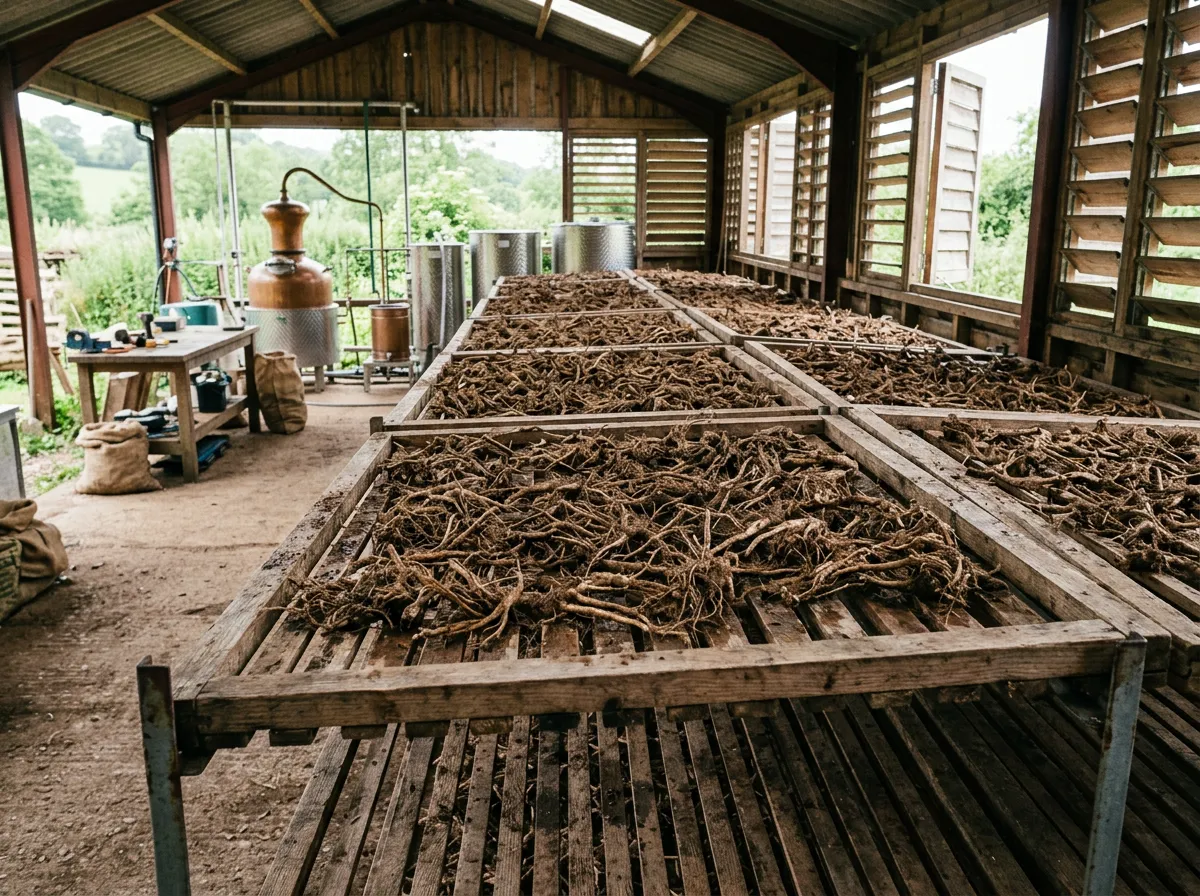
Valerian's famous smell is not simply extracted from the root. It develops while the root dries, which makes the drying shed more important than the still.
The smell people either love or flee from is created during drying, not during distillation.
As the root dries, valerenic acid derivatives break down and isovaleric acid forms. That is the source of the animalic, old-gymnasium note valerian is notorious for, and heat accelerates the whole process. Dry the root too hot or too slowly and you get an oil considerably harsher than it needed to be.
So we hold it below forty degrees, in shade, with active airflow: low and steady. The result is closer to the root's actual character, deep and musky rather than merely pungent. We also dry it in a separate space, because valerian will scent everything within reach of it, including other people's material.
No medical claims are made here. Valerian's traditional reputation is long and well known, and it is not a promise we are entitled to repeat.
The honest warning is about the smell. Valerian is genuinely divisive: to some noses it is deep, musky and beautiful, and to others it is simply unpleasant. It is also tenacious, and it will scent a room, a cupboard and your hands. Buy the smallest size first and find out which camp you are in before committing to more.
Bring it well down in a carrier before skin contact and trial a small area. Use it in traces in a blend rather than by the drop; it will dominate anything it is put beside. Avoid it in pregnancy as a precaution, and do not combine it with sedative medication.
If a lot does not analyse the way properly dried root should, we hold it back and go short rather than bottling it.
Root is the hardest of all botanical material to get clean, and soil carried into a still is soil carried into the oil. Ours is washed repeatedly in cold running water, then hand-trimmed to take off the crown, the fine rootlets and anything the wash missed.
Only then does it go to the racks, and only after drying does it reach the still. The distillate is dark, viscous and dramatically aromatic, which is exactly what a properly dried root should give.
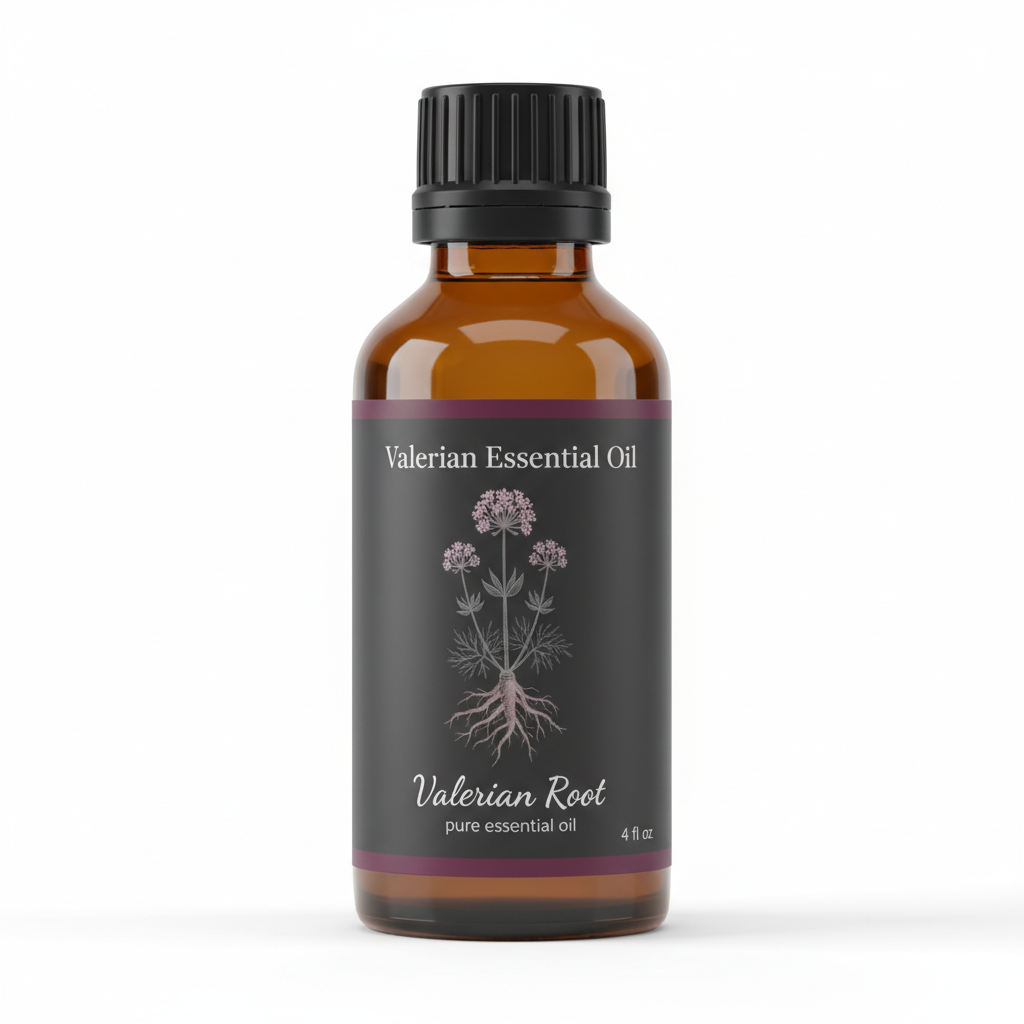
Every lot then goes out for analysis before a bottle is filled. Both dates and a lot number go on the bottle, in amber glass, and nothing is added to it.
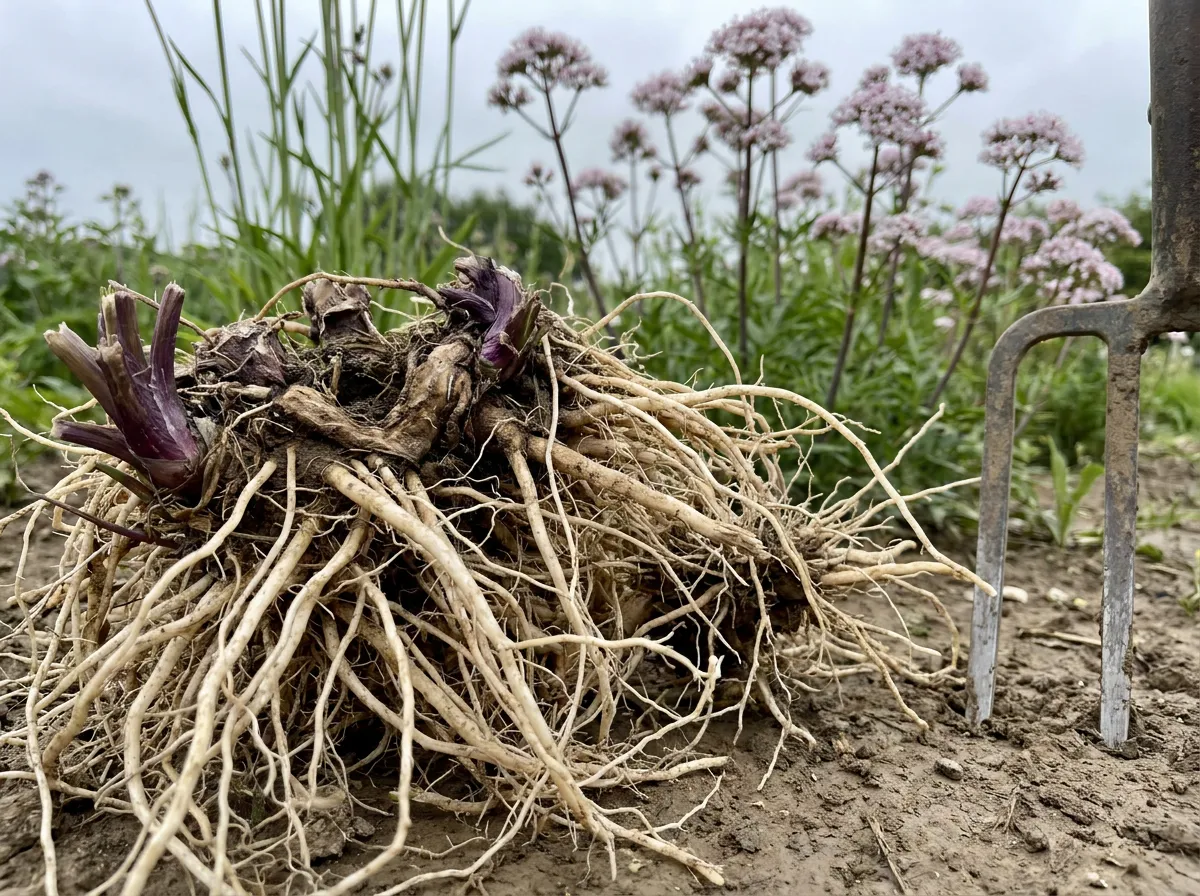
Valerian is left in the ground for two seasons. First-year roots are thin and give little, and the compounds worth distilling accumulate across the second summer.
We lift after the aerial parts have died back. A plant still pushing top growth is spending its resources upward, and lifting then takes root that has not finished the job.
It comes up with a fork, by hand. The root is a dense fibrous mass that shatters if it is pulled mechanically, and a shattered root means more cut surface losing volatiles and more soil driven down into the crevices.
An independent laboratory analyses each lot, which on a material this distinctive is about consistency rather than reassurance.
The root's own marker compounds, and the family whose breakdown during drying produces valerian's signature note.
The compound behind the animalic edge. Its level is largely a record of how the root was dried.
Confirms Valeriana officinalis at full strength, rather than another Valeriana species or a diluted lot.
Quote your lot number for the profile, or ask us through the contact page.
What holds for every valerian lot we run.
Lifted in the second autumn, after the top growth has died back.
Hand-lifted so the fibrous root mass comes up whole rather than shattered.
Shade drying with active airflow, because heat coarsens the aroma permanently.
Independent measurement of the marker compounds, available on request.
Repeated cold water and hand-trimming, because soil in the still means soil in the oil.
Dried and stored in its own space so it does not scent everything else we make.
Distillation and bottling dates with a lot number, in amber glass, undiluted and with nothing added.
Second-autumn root, hand-forked, washed and trimmed, dried low and slow in its own shed, with the marker compounds measured by an outside laboratory.
Then decide if it is for you.
Shop Valerian Oil