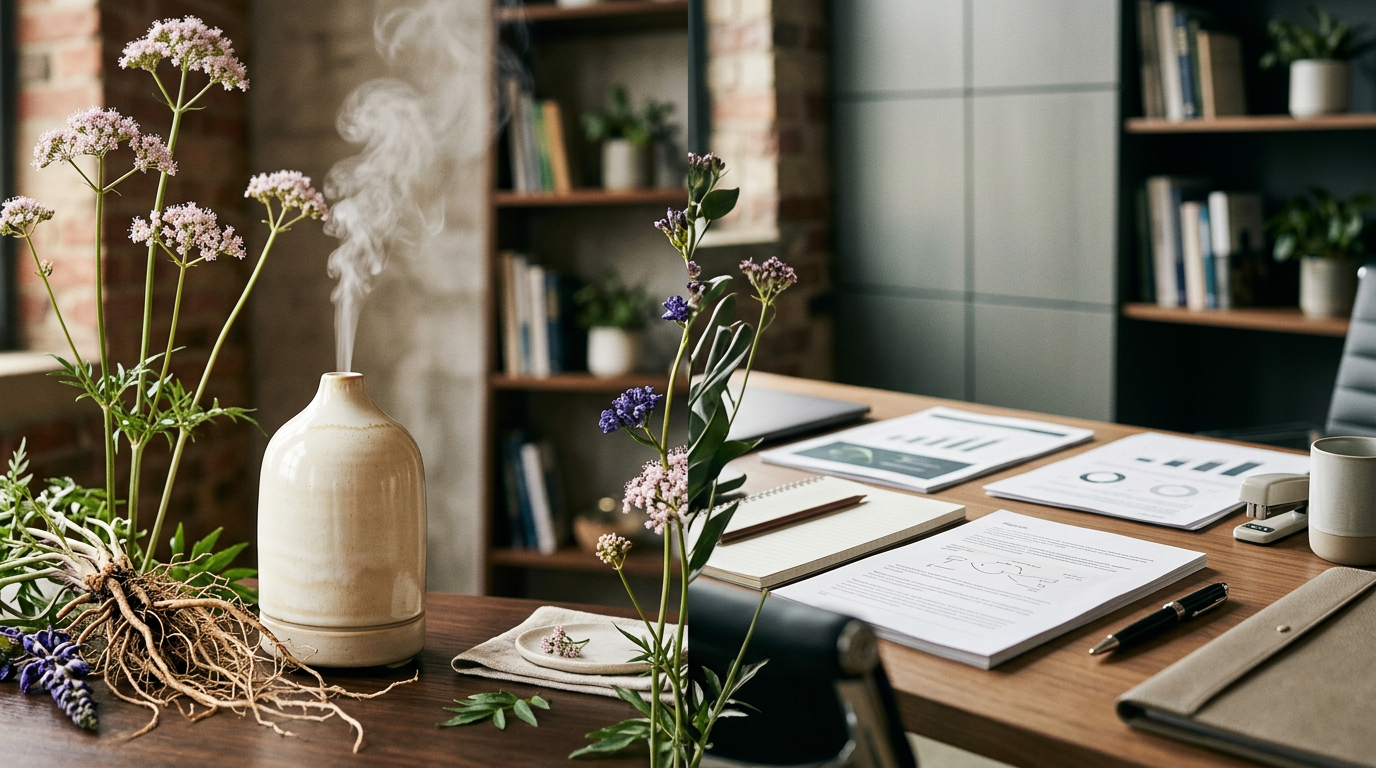
An Evening Wind-Down Ritual with Valerian: Diffuse, Dim, Breathe
Some evenings resist slowing down. The lights stay bright, the screen stays on, and the mind keeps cycling through whatever the day left unfinished. This is a familiar pattern for a lot of people, and it has less to do with willpower than with environment. The space around us either supports a shift in pace or it actively works against it.
This case study explores how one person built a structured valerian evening ritual over the course of four weeks, using diffusion as the anchor point and layering in simple environmental changes to support a more intentional transition from the active part of the day into the quieter part. The observations here are personal and educational in nature. They are not a clinical record, and nothing in this piece should substitute for professional guidance.
The Context: When Evening Doesn't Feel Like Evening
The subject of this case study, a freelance writer working from home, described her evenings as "blurry." Work bled into dinner. Dinner bled into scrolling. By the time she got into bed, her mind was still operating at a pace that didn't match the hour. She wasn't looking for a product. She was looking for a signal. Something that would tell her body: this part of the day is different from the last part.
She had experimented with lavender before and appreciated it, but found the scent too familiar, almost invisible after extended use. A botanist friend suggested she try valerian root oil. She was skeptical. The reputation of valerian as earthy, rooty, and borderline funky preceded it. But she ordered a small bottle anyway.
What followed was a four-week exploration of how a bedtime room ritual built around valerian oil, paired with lighting adjustments and intentional breathwork, changed the texture of her evenings. Not dramatically. Not overnight. Gradually, and in ways that felt worth documenting.
The Approach: Three Layers, One Ritual
The ritual was designed around three elements that could work together without requiring significant effort or expense. Each layer addressed a different sensory channel: scent, light, and breath. The goal was to create enough environmental contrast between "working hours" and "wind-down hours" that the shift became automatic over time.
Layer One: Diffusion
Valerian essential oil is not a gentle or crowd-pleasing scent in isolation. It carries deep, damp, root-forward notes with a slight bitterness that can read as pungent on first encounter. This is precisely what makes it interesting for an evening context. It doesn't smell like any other part of the day. It smells like something specific and deliberate.
The approach here was to use valerian as a minor but anchoring note in a wind-down diffuser blend, rather than running it solo at full strength. The first two weeks used the following blend in a 200ml ultrasonic diffuser:
- 2 drops valerian essential oil
- 3 drops cedarwood essential oil
- 2 drops sweet orange essential oil
The cedarwood softened the sharper edges of the valerian while adding its own woody depth. The sweet orange introduced a touch of brightness that kept the blend from feeling heavy. After a week, the ratio shifted slightly, adding one more drop of valerian to increase its presence without overwhelming the room.
For more structured blend ideas built around this oil, eight valerian diffuser blends worth exploring are worth a look, especially if you want to move beyond the standard cedarwood pairing.
The diffuser ran for 30 minutes starting at the same time each evening, roughly 90 minutes before she planned to be in bed. Consistency mattered more than intensity. The scent needed to become associated with a particular window of time, not just with relaxation as a general concept.
Layer Two: Lighting
Scent alone was not enough. The overhead lights in her apartment were on timers during the workday for productivity. She added a second phase to those timers: at the same moment the diffuser started, the overhead lights switched off and two low-wattage amber lamps came on instead.
This was a small change. It felt significant. The room looked different. Combined with the scent now building in the air, the environmental shift was noticeable enough to interrupt the autopilot pattern of continuing to work or scroll.
She described it this way: "The room stopped being a workspace. It started being somewhere else."
Layer Three: Breathwork
The breathwork component was simple, not a formal practice. For the first five minutes after the diffuser and lamps came on, she sat without a screen and breathed slowly. No app, no guided audio. Just attention placed on the exhale, which she extended slightly longer than the inhale.
This is a common technique in breath-focused practices, sometimes called extended exhale breathing or a 4-6 pattern (four counts in, six counts out). The valerian scent served as a focal point during this time. Having something specific to smell made it easier to stay present rather than mentally drifting back to the to-do list.
Some readers pair the diffuser with a cup of the root, and valerian tea vs valerian oil explains how the two habits differ.
Observations: What Shifted Over Four Weeks
This section is framed carefully. These are observations from one person's self-reported experience over a short period. They are not data points in a clinical sense. They are patterns worth noting for anyone interested in building their own valerian evening ritual.
Week One
The valerian scent was polarizing at first. She described it as "like wet forest floor" and acknowledged it required an adjustment period. She did not find it unpleasant exactly, but it was unfamiliar enough to be slightly distracting. The breathwork felt awkward without a prompt. She reported noticing the transition between the bright work environment and the dim lamp environment more than anything else.
Week Two
By the middle of the second week, she reported that the scent had begun to feel less strange and more expected. "I walk into the room and I already know what it's going to smell like," she noted. "That's actually nice." She extended the breathwork from five minutes to ten, adding a brief journal entry afterward. The ritual began to feel like a sequence rather than a set of unconnected actions.
Week Three
This was the week she described as a turning point. She noticed that she had started anticipating the ritual during the late afternoon, which she interpreted as a sign that her nervous system had begun to associate it with a particular kind of ease. The scent of valerian on its own, when she caught a whiff from the bottle during the day, prompted a noticeable shift in her attention. Whether this reflects a conditioned response or something else is beyond the scope of this piece, but the pattern was consistent enough to be worth noting.
She also noted that the room itself felt different in the morning. Faint traces of the cedarwood-valerian blend lingered in the textiles, making the space feel associated with quietness even during daylight hours. This surprised her.
Week Four
By the final week, the ritual had become low-effort. She no longer had to remember it or prompt herself. The timers handled the light shift, the diffuser handled the scent, and the five-to-ten minutes of breathing had become something she looked forward to rather than something she had to schedule. She described it as "the most reliable part of my day, which is strange because it's the part where I'm doing the least."
She noted that she was not getting more hours of rest, but that the transition into the evening portion of her day felt less abrupt. Whether that distinction matters depends on what you're trying to build. For her, it mattered quite a bit.
Key Learnings
Four weeks is a short window, and one person's experience is not a blueprint. But there are a few principles from this exploration that seem worth carrying forward.
Consistency Creates Association
The most important variable was not the specific oil or blend. It was the repetition. Running the same scent at the same time under the same lighting conditions built an environmental cue that her brain began to recognize. Scent is one of the most direct routes to associative memory. Valerian's distinctiveness, the quality that makes it hard to love at first, is also what makes it a strong candidate for this kind of ritual anchoring. It doesn't blend into the background.
Valerian Works Better as Part of a Blend
Running valerian solo at full diffuser strength is possible, but the results are an acquired taste. A supporting cast of cedarwood, sandalwood, frankincense, or citrus top notes makes the blend more livable and more likely to sustain regular use. For anyone new to this oil, starting with a low ratio (1 to 2 drops in a 200ml diffuser) and adjusting from there is a sensible approach.
If you want a starting point beyond this blend, the complete guide to evening rituals with valerian oil covers a range of applications, including diffusion, topical use (properly diluted), and linen applications.
The Room Is Part of the Ritual
Scent does not exist in isolation. The same oil smells different in a bright overhead-lit room than it does in a dim amber-lit one. The environmental context shapes the experience. Treating the ritual as a whole, rather than as a series of separate steps, is what gives it cohesion. Diffuse, dim, breathe: each part reinforces the others.
A Linen Mist Extends the Effect
In the final two weeks, she began adding a light spritz of a DIY valerian linen mist to her pillowcase after making the bed each morning. This meant the scent association carried into the earliest and latest moments of the day. If you're interested in making one yourself, this DIY valerian pillow mist guide covers the proportions and carrier options in detail.
Another reader took a slower route to the same habit, and the notes are in a quiet-house valerian diffuser routine built over several weeks.
A Note on Safety and Sourcing
Valerian essential oil is potent and should always be used with care. For topical applications, proper dilution is essential: most aromatherapy guidelines suggest no more than 1 to 2 percent dilution in a carrier oil, which works out to roughly 6 to 12 drops per ounce of carrier. A patch test on a small area of skin before broader use is strongly recommended.
If you are pregnant, nursing, or managing any health condition, please consult a qualified healthcare provider before incorporating new essential oils into your routine. Children and pets have different sensitivities than adults; check species-specific guidance before diffusing in shared spaces.
On the sourcing side, quality varies significantly between valerian oil suppliers. Look for oils that list the full botanical name (Valeriana officinalis), specify the plant part (root), the extraction method (steam distillation), and the country of origin. Transparency on these details is a reasonable baseline indicator of quality.
Closing Thoughts
This case study does not argue that valerian oil will transform your evenings. It argues something more modest: that building a consistent, scent-anchored bedtime room ritual is a practical way to create environmental contrast between the busy and the quiet parts of your day. Valerian is a useful tool for that purpose, not because it is magic, but because it is distinctive, botanical, and grounding in a way that few other oils are.
Four weeks. Three layers. One oil that smells like the forest floor after rain. It turns out that's enough to start building something.