
A Short History of Valerian: From Ancient Apothecaries to Modern Shelves
Few botanical ingredients carry as much historical weight as valerian. Its roots, quite literally, have been dug up, dried, traded, and debated across thousands of years of human civilization. Today, valerian essential oil sits on modern shelves alongside sleek, minimalist packaging and QR codes linking to third-party lab reports. The distance between an ancient Greek apothecary and a contemporary aromatherapy cabinet feels vast. Yet the plant at the center of both is virtually the same: Valeriana officinalis, a tall, flowering perennial with a root system that smells, to put it diplomatically, assertively earthy.
This deep dive traces that long arc, from classical antiquity through medieval herb gardens, into the laboratories of modern phytochemistry, and finally onto the quality-conscious shelves where sourcing and purity matter as much as tradition.
Valerian History: The Ancient Record
Written references to valerian stretch back at least two thousand years. Dioscorides, the Greek physician whose first-century text De Materia Medica served as the foundational pharmacopoeia for well over a millennium, described a plant he called Phu (a name almost certainly inspired by its aroma) with aromatic properties worth cataloguing. Galen, writing in the second century, also mentioned it. These early references were observational and descriptive in nature, focused on the plant's sensory qualities and its place within the broader ecosystem of aromatic botanicals known to the classical world.
The name Valeriana itself likely derives from the Latin valere, meaning to be strong or to be well. Some historians suggest it may reference the Roman province of Valeria in what is now Hungary, a region where the plant grew abundantly. Either etymology points toward an ingredient that commanded respect in its time.
By the medieval period, valerian root tradition was firmly embedded in European herbal practice. Monastic gardens, which functioned as the research institutions of their era, cultivated valerian alongside other aromatic plants. Hildegard von Bingen, the twelfth-century abbess and prolific writer on botanical matters, noted valerian in her texts. It appeared in herbals throughout the fourteenth, fifteenth, and sixteenth centuries, with botanical illustrators rendering its distinctive pinnate leaves and clusters of pale pink flowers in careful detail.
The Renaissance and the Shift Toward Distillation
The sixteenth century brought advances in distillation technology that changed how aromatic plants were understood and used. Where earlier practice worked primarily with dried root powders, infused oils, and decoctions, the spread of alembic distillation across Europe opened up a new category: essential oils. Valerian was among the plants that early distillers worked with, though producing a consistent, high-quality oil from its roots presented challenges that persist to this day.
John Gerard's 1597 Herball and Nicholas Culpeper's mid-seventeenth-century writings both documented valerian extensively, situating it within the humoral frameworks of their time. These texts are not scientific sources by modern standards, but they are valuable records of how the plant was perceived, described, and positioned within the botanical knowledge systems of their era.
By the eighteenth century, valerian root was a recognized trade commodity. European apothecaries stocked it. Pharmacopoeias in Britain, France, and Germany listed it formally. The valeriana officinalis history at this stage is, in part, a commercial history: one of dried root shipments, tincture preparations, and the economics of medicinal herb cultivation.
Chemical Composition: What Is Actually in the Root
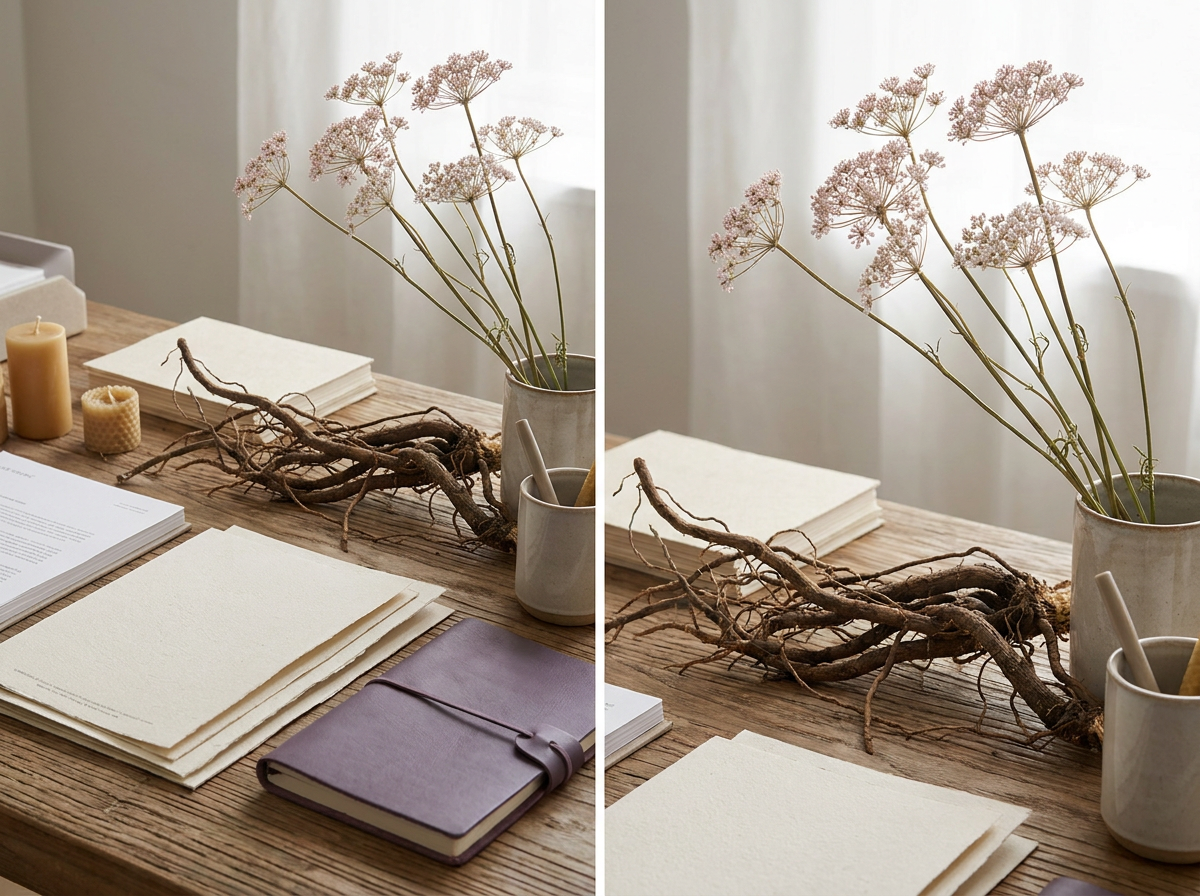
Modern phytochemistry has given us a much clearer picture of what makes valerian root chemically distinctive. The essential oil derived from the root is complex, and its composition can shift significantly based on geographic origin, harvest timing, root age, and drying methods.
Key Compounds
- Isovaleric acid: This short-chain fatty acid is largely responsible for valerian's polarizing aroma profile. It is pungent, earthy, and persistent. Some describe it as reminiscent of aged cheese or worn leather. Isovaleric acid is also found, in smaller concentrations, in some aged wines and fermented foods.
- Bornyl isovalerate: A significant ester in the oil, bornyl isovalerate contributes a softer, slightly woody character that tempers the sharpness of isovaleric acid. It is one of the compounds that experienced formulators work with when blending valerian into larger aromatic compositions.
- Camphene and borneol: These monoterpene-related compounds add a cool, slightly camphoraceous facet to the oil's overall profile.
- Valeranone and valerenal: Sesquiterpene compounds that contribute depth and earthiness. Valeranone in particular is considered a marker compound for quality assessment in analytical work.
- Valerenic acid and its derivatives: These sesquiterpene acids are found in the root material and may carry over into certain extraction products, though their concentration in steam-distilled essential oil varies. Some research suggests these compounds interact with neurological receptor systems, though the mechanisms remain an active area of scientific observation rather than settled conclusion.
The ratio of these compounds in any given batch of valerian essential oil depends heavily on the source. Steam-distilled oils from freshly harvested roots differ from those produced using dried root material. CO2 extractions capture a broader range of heavier molecular compounds. For those interested in the full aromatic profile, a recent batch-specific gas chromatography and mass spectrometry (GC/MS) report from a reputable supplier is the most reliable reference point. You can read more about the full range of what the oil contains in our complete guide to valerian essential oil.
What Research Suggests: A Careful Look at the Science
Valerian has attracted genuine scientific attention, particularly over the last four decades. The volume of published research is notable, even if much of it involves root extracts and standardized preparations rather than the essential oil specifically.
Some research suggests that valerenic acid may interact with gamma-aminobutyric acid (GABA) receptor systems in ways that could be relevant to relaxation responses, though researchers are careful to note that in vitro findings do not map directly onto whole-organism outcomes. Other observations have examined isovaleric acid's potential role in the plant's overall activity profile.
Studies published in journals including Phytomedicine and Pharmacology, Biochemistry and Behavior have looked at valerian preparations in the context of sleep quality and calm-state promotion. The findings have been mixed. Some suggest modest, positive associations. Others show results comparable to placebo. The scientific picture is genuinely complex, and researchers consistently call for larger, more rigorously controlled studies before drawing firm conclusions.
For essential oil users, it is worth noting that aromatherapy applications involve inhalation or topical use at high dilution, which is a different delivery context than the oral extracts studied in most published research. Drawing a direct line between that research and aromatherapy outcomes would go further than the evidence currently supports.
Safety Profile and Contraindications

Valerian essential oil is generally considered safe for aromatic and topical use when used appropriately. That qualifier matters. Here is what careful use looks like in practice.
Dilution
For topical applications, valerian essential oil should be diluted in a carrier oil before skin contact. A dilution of 0.5 to 1 percent is a reasonable starting point for most adults, meaning roughly 3 to 6 drops per ounce of carrier oil. Higher concentrations are not necessarily better and increase the likelihood of skin sensitivity reactions.
Patch Testing
A patch test on a small area of skin (the inner forearm is a common choice) before broader topical use is always advisable. Apply the diluted oil, wait 24 hours, and observe for any redness, itching, or irritation before proceeding.
Populations Who Should Consult a Healthcare Provider First
- Pregnant or nursing individuals
- Children under 12 years of age
- Individuals currently using any prescription or over-the-counter medications, particularly those affecting the central nervous system
- Individuals with known sensitivities to plants in the Caprifoliaceae family
It is also worth knowing that valerian has a well-documented and somewhat legendary effect on cats. If you keep felines at home, store your valerian oil securely. For more on why cats respond so strongly to this particular root, our article on valerian oil and cats covers the topic in full.
Always consult a qualified healthcare provider before incorporating any new botanical ingredient into your routine, especially if you have existing health considerations.
Sourcing and Quality Indicators
The long history of valerian as a traded commodity means that quality variation has always been part of its story. Today, the markers of a high-quality valerian essential oil are specific and verifiable.
Botanical Source and Origin
Look for oils clearly labeled as Valeriana officinalis. There are over 200 species within the Valeriana genus, and while some are used in regional botanical traditions, V. officinalis is the most studied and the most widely established in the essential oil trade. Country of origin matters: Belgium, the Netherlands, Eastern Europe (particularly Hungary and Bulgaria), and parts of China are significant production regions. Each geography produces oils with slightly different chemical profiles due to soil, climate, and agricultural practice.
Extraction Method
Steam distillation from the dried root is the most common method and produces the aroma profile most consistent with historical and modern expectations. CO2 extractions are also available and tend to capture a broader molecular spectrum, which some formulators prefer. The method should be clearly stated on the product label or in the supplier's documentation.
Third-Party Testing
A current GC/MS report from an independent laboratory is the most reliable quality indicator available to consumers. It should show the presence of key marker compounds (including valeranone and bornyl isovalerate) in expected ranges, and the absence of adulterants. Reputable suppliers make these reports readily available, either on their websites or on request.
Color, Viscosity, and Aroma
Valerian essential oil typically ranges from pale yellow to olive-brown. It is slightly more viscous than many lighter essential oils. The aroma is unmistakably earthy and pungent when smelled directly, with depth that opens over time on a diffuser or blotter strip. An oil that smells flat, faint, or oddly sharp may indicate age, adulteration, or improper storage. Speaking of which: proper storage significantly extends shelf life and preserves aromatic integrity. Our guide to storing valerian oil covers everything you need to know about keeping this oil in peak condition.
From Ancient Root to Modern Bottle
The thread connecting Dioscorides documenting Phu in the first century to a contemporary buyer scanning a QR code for a GC/MS report is surprisingly unbroken. What has changed is the precision of our tools and the transparency of our supply chains. What has remained constant is the plant itself: the same gnarly, pungent root, with the same complex aromatic chemistry, pulling the same quiet fascination from botanically curious people across the centuries.
Valerian root tradition has always lived at the intersection of the earthy and the refined, the practical and the poetic. Understanding its history, its chemistry, and its sourcing requirements does not diminish that. If anything, knowing what you are working with makes the experience of using it richer.