Valerian Oil and Cats: Why Felines Flip for This Root
If you have ever opened a bottle of valerian essential oil near a cat and watched the animal lose all composure, you are not alone. Cats roll, rub, purr, and generally act as though you have offered them something extraordinary. This page collects the most common questions pet owners, aromatherapy enthusiasts, and curious cat companions ask about the valerian cats reaction, how valerian oil for cats compares to catnip, and what it all means for your household routines. Answers are grouped by theme so you can jump straight to what you need.
Before we begin: the information here focuses on observational and behavioral topics only. Valerian essential oil is not a veterinary product. Always speak with a licensed veterinarian before introducing any new scent, plant, or substance into your pet's environment.
The Basics: What Is Valerian and Why Do Cats Care?
1. What is valerian essential oil?
Valerian essential oil is steam-distilled from the root of Valeriana officinalis, a flowering plant native to Europe and parts of Asia. The resulting oil is thick, earthy, and intensely aromatic, with a scent profile that many humans find bold and complex. For a full botanical background, see our complete guide to valerian essential oil.
2. Why do cats react so strongly to valerian?
Researchers believe the key compound is actinidine, a chemical found in valerian root that appears to mimic certain feline pheromones. Cats detect it through their highly sensitive olfactory system, and many respond with behaviors that look a lot like playful excitement or deep contentment. The reaction is largely scent-driven, which is why even a diffused trace of the oil can set a cat off from across the room.
3. Is it the essential oil specifically, or the whole root?
The reaction can be triggered by the dried root, a root-based product, or the concentrated essential oil, because the aromatic compounds are present in all forms. The essential oil is simply a concentrated extraction, so its scent output is more potent than a handful of dried root. Proximity and concentration level both influence how strongly a cat responds.
4. Do all cats react to valerian?
No. Just as roughly 30 to 50 percent of cats are genetically unresponsive to catnip, some cats show little or no interest in valerian at all. Sensitivity appears to be individual and may have a genetic component. Kittens under about six months and some older cats tend to show more muted responses than adult cats in their prime.
Valerian vs. Catnip: How Do They Compare?
5. What is the main difference between valerian and catnip for cats?
Catnip (Nepeta cataria) works primarily through nepetalactone, a compound that binds to feline nasal receptors and produces a well-documented euphoric-style response. Valerian operates through a different compound, actinidine, and is sometimes described as producing a more prolonged or intense behavioral reaction in cats that are unresponsive to catnip. They are chemically distinct plants that happen to produce overlapping behavioral effects in many cats.
6. Can a cat react to both valerian and catnip?
Yes, and many do. A cat that goes wild for catnip may also respond enthusiastically to valerian, though the intensity can differ between the two. Likewise, a cat that ignores catnip entirely might have a strong reaction to valerian, which makes valerian a useful option for owners of "catnip-indifferent" cats.
7. Which one lasts longer?
Anecdotal reports from cat owners suggest that the valerian cats reaction often lasts longer than the typical catnip response, sometimes continuing for 15 to 30 minutes rather than the 5 to 10 minutes commonly observed with catnip. Individual variation is significant, so results will differ from cat to cat. Neither substance produces a lasting behavioral change once the scent dissipates.
8. Is valerian safer than catnip for cats?
Both plants have long histories of use in cat enrichment products, and neither is considered broadly dangerous when used appropriately in small amounts. That said, safety questions about any substance near pets belong with your veterinarian, not with an essential oil FAQ page. Please consult a vet before making decisions based on what you read here.
9. Are there other plants that produce similar reactions in cats?
Yes. Silver vine (Actinidia polygama), Tatarian honeysuckle wood, and Acalypha indica are three other plants known to produce catnip-like responses in cats. Interestingly, silver vine also contains actinidine, which may explain why it and valerian produce similar reactions. Research into feline plant sensitivity is ongoing and genuinely fascinating.
Using Valerian Oil Around Cats: Practical Questions

10. Can I diffuse valerian essential oil if I have cats in the house?
This is a question for your veterinarian, not for an essential oil content page. Essential oils in diffused form introduce concentrated aromatic compounds into shared air, and cats metabolize certain substances very differently from humans. A vet familiar with your specific cats can give you guidance based on their health, age, and any individual sensitivities.
11. Can I apply valerian oil directly to a cat's fur or skin?
No. Applying undiluted essential oils directly to any animal is not appropriate. Cats in particular have unique skin permeability and metabolic considerations that make topical essential oil use a matter for veterinary guidance only. If you are interested in valerian-based cat enrichment, look for products specifically formulated and tested for feline use.
12. My cat went absolutely frantic when I opened my valerian oil. Should I be concerned?
A dramatic behavioral reaction, rolling, rubbing, vocalizing, and general exuberance, is typical and expected. It usually subsides on its own once the cat moves away from the scent source. If you notice labored breathing, prolonged disorientation, or any physical symptom that worries you, contact your veterinarian promptly.
13. How far away from a cat should I keep my valerian oil?
Valerian is one of the most aromatic essential oils available, so even a sealed bottle stored nearby can emit trace scent. If your cat is highly reactive and you want to avoid triggering a response, store the oil in a sealed cabinet or drawer, in a room the cat does not access regularly. Our storage guide has more on keeping the oil contained and fresh: how to store valerian oil.
14. My cat tried to bite or chew the bottle. Is that dangerous?
A glass bottle of essential oil is never safe for a cat to chew or bat around. Remove the bottle immediately and store it securely. If a cat has ingested any quantity of essential oil, contact a veterinarian or an animal poison control hotline right away. Do not wait to see if symptoms develop.
The Science Behind the Reaction
15. What exactly is actinidine and where does it come from?
Actinidine is an iridoid compound found in several plants, including valerian root and silver vine. Research published in feline behavioral science journals has identified it as a probable trigger for the rolling and rubbing behaviors cats display. It appears to activate the same neurological pathway associated with catnip sensitivity, though through slightly different receptor interactions.
16. Why do cats roll and rub when they encounter valerian?
Current research suggests the rolling and face-rubbing behaviors may serve a functional purpose beyond simple enjoyment. One hypothesis is that rubbing transfers the aromatic compound onto the cat's fur, which could have originally provided some ecological benefit to wild ancestors. Regardless of the evolutionary origin, the behavior is considered normal and is not a sign of distress.
17. Is the valerian reaction the same as intoxication?
The word "intoxication" implies a harmful substance, and that framing is not well-supported by current evidence for catnip-like plant reactions. Most researchers describe the response as a temporary, self-limiting behavioral state that the cat exits naturally. It is not comparable to the effects of substances known to cause dependence or harm in animals.
18. Can cats become dependent on or habituated to valerian?
Some owners report that cats shown valerian very frequently seem to respond less intensely over time, which mirrors what is observed with catnip. A common practice is to offer valerian-based enrichment items only occasionally, such as once or twice a week, to maintain the novelty. This is an observational pattern, not a medically documented phenomenon, so ask your vet if you have specific concerns.
Valerian for Human Aromatherapy vs. Cat Enrichment: Drawing the Line
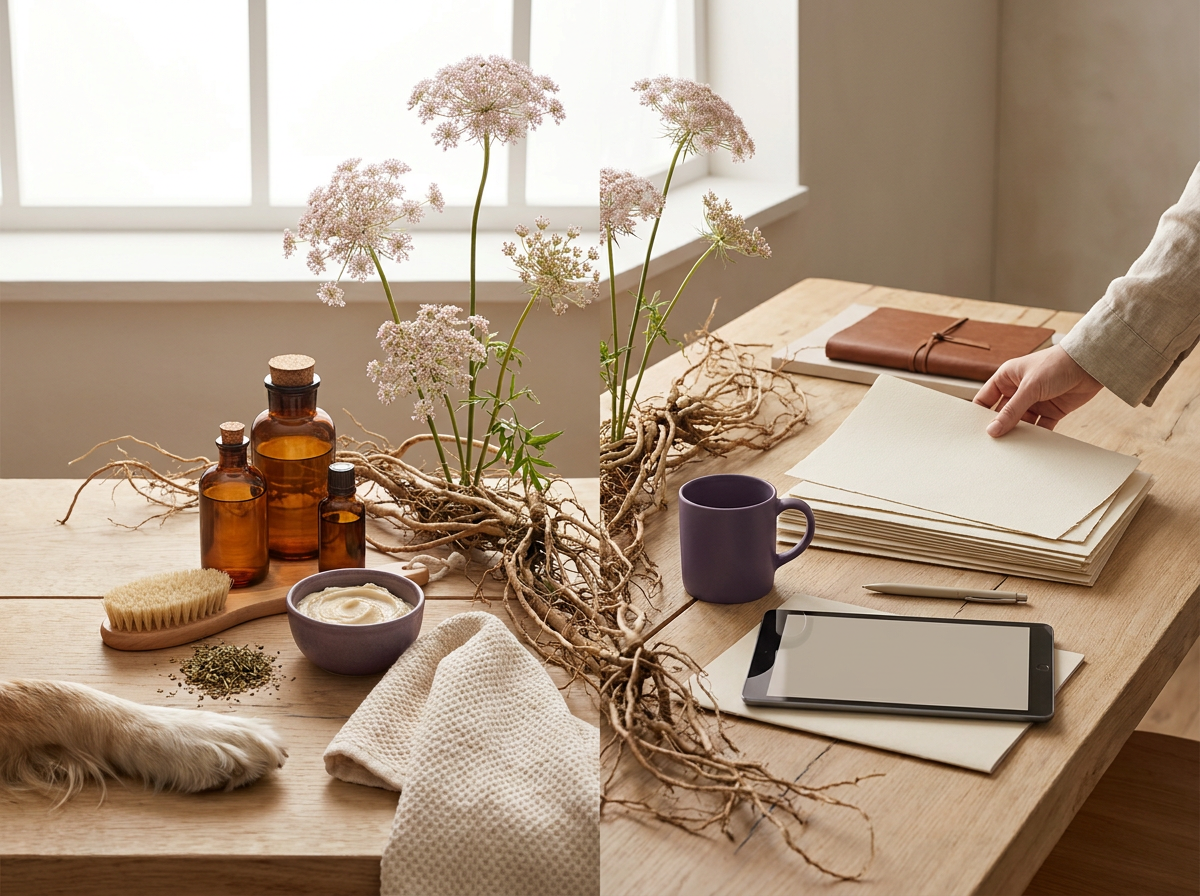
19. I use valerian oil in my personal wind-down routine. Does that mean my cat will always be disrupted?
Not necessarily. Cats that are highly reactive will likely notice if you apply valerian to your skin or use it near them, but a tightly capped bottle stored in another room produces minimal scent. Planning your personal aromatherapy rituals in a space your cat does not routinely occupy is usually enough to keep things calm. See our broader valerian essential oil FAQ for more on personal use routines.
20. Are valerian products marketed for cats the same as valerian essential oil for aromatherapy?
No. Pet enrichment products containing valerian are formulated, diluted, and tested specifically for animal use, often in dried herb or spray form rather than concentrated essential oil. Aromatherapy-grade valerian essential oil is intended for human use contexts and is not a pet product. These are different categories, and the distinction matters.
21. Can I use the valerian reaction to help my cat settle before a car ride or a visit to the vet?
This falls into veterinary behavioral guidance territory, and any plan for managing a cat's responses to stressful situations should be discussed with your vet. Introducing a potent new scent into an already stressful environment could have unpredictable results, and a professional can help you evaluate the options.
22. My cat is not reacting at all to valerian. Is something wrong?
Non-reactivity is completely normal and requires no intervention. As noted earlier, a significant percentage of cats simply do not respond to valerian or catnip, and that is a genetic variation, not a health signal. If you are concerned about your cat's sensory responses for other reasons, a routine vet checkup is always a reasonable step.
Sourcing and Quality Considerations
23. Does the quality of valerian essential oil affect how strongly a cat reacts?
It is reasonable to think so. A higher-quality oil distilled from properly harvested roots will contain a fuller spectrum of volatile compounds, including actinidine. Adulterated or low-quality oils may have a weaker or chemically incomplete scent profile, potentially producing a muted response. Sourcing from a reputable supplier who provides batch-level testing documentation is good practice for any essential oil purchase.
24. What should I look for when buying valerian essential oil?
Look for oils labeled with the full botanical name (Valeriana officinalis), country of origin, distillation method, and a batch-specific GC/MS (gas chromatography/mass spectrometry) report. These details indicate a supplier invested in transparency. Thick viscosity and a deeply earthy, complex scent are signs of a quality extraction.
25. Where can I learn more about valerian essential oil beyond the cat connection?
Valerian has a rich history as a botanical ingredient that extends well beyond feline fascination. Its earthy, grounding scent profile makes it interesting for personal aromatic rituals, perfumery, and cosmetic formulation. Explore the full story in our complete guide to valerian essential oil, and find answers to more general questions in our valerian essential oil FAQ for curious noses.
Quick Reference: Valerian vs. Catnip at a Glance
| Feature | Valerian Root / Oil | Catnip |
|---|---|---|
| Key active compound | Actinidine | Nepetalactone |
| Plant family | Caprifoliaceae | Lamiaceae (mint family) |
| Estimated % of cats that react | Widely observed; percentage not firmly established | Roughly 50 to 70% |
| Typical reaction duration | Reports suggest 15 to 30 min | Commonly 5 to 10 min |
| Useful for catnip-indifferent cats? | Often yes | Not applicable |
| Appropriate for direct topical use on cats? | No (consult vet) | Dried herb: sometimes; oil: consult vet |
A note on veterinary guidance: Every question on this page that touches on your specific cat's wellbeing deserves a real answer from a licensed veterinarian. Essential oil content writers are not vets. The information here is educational and observational. When in doubt, call your vet.